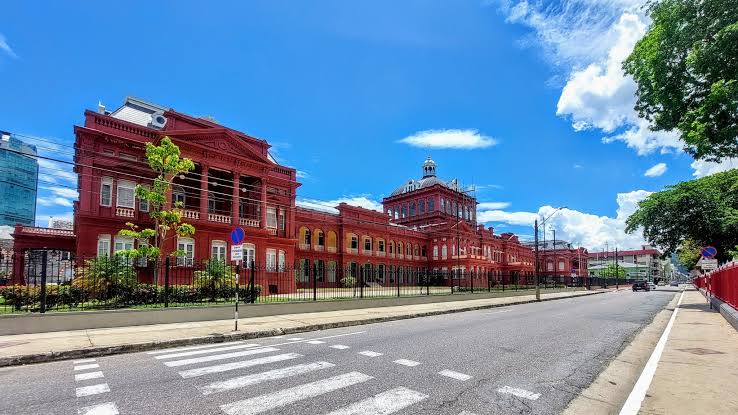
On Monday, 2 November, the United Nations General Assembly adopted its annual resolution on the International Criminal Court by 93 votes to 13, with 36 abstentions. Trinidad and Tobago was among the abstentions. It was the first time the country had withheld its support since the Assembly began adopting the resolution in 2005.12
This year's text was not a courtesy. Resolution A/81/L.11 welcomed the Court's report, called on states to cooperate in arrests, the gathering of evidence and the enforcement of sentences, and condemned threats, attacks and interference against the Court, its personnel and those cooperating with it. The Court, the Assembly said, must be able to work “without intimidation”. The words were adopted on the day the Court's President addressed the Assembly by video, because she is under United States sanctions.114
A/81/L.11 · What Trinidad and Tobago declined to support
Five things the resolution said
For Trinidad and Tobago, the vote carries a weight it cannot carry for most of the other 35 abstainers. This country did not merely endorse the International Criminal Court. Through Arthur N. R. Robinson, we helped bring it into existence. Our contribution became part of the architecture of international criminal justice. The decision to abstain is consequently not just another diplomatic vote. It raises a fundamental question about whether we are retreating from the very principles we helped establish.
The record
The court Port of Spain set in motion
Robinson's commitment predates his premiership by three decades. At Oxford in the 1950s, he and a fellow student, Robert Woetzel, resolved to revive the idea of a permanent tribunal for crimes against humanity, a concept that dated back to the League of Nations. In 1972 the two men set up the Foundation for the Establishment of an International Criminal Court.12 Speaking to students at the University of the West Indies in 1969, Robinson warned that “the world today is on a collision course with its own inhumanity and anything that rescues it from this course will have made the greatest contribution of our time.”7
In 1989, as Prime Minister, he put the question back before the United Nations. Trinidad and Tobago, supported by every CARICOM state, asked the General Assembly to consider an international criminal court with jurisdiction over drug trafficking and other transnational crime. The Assembly adopted the resulting resolution, 44/39, by consensus on 4 December 1989. The International Law Commission's draft statute of 1994 became the basis for the negotiations that followed.101121
The drug-trafficking focus did not survive those negotiations. The wars in the former Yugoslavia and the genocide in Rwanda moved the emphasis to genocide, war crimes, crimes against humanity and aggression. The Rome Statute was adopted on 17 July 1998 and entered into force on 1 July 2002.21 Robinson described his own part plainly two months before Rome: as Prime Minister he had “raised and succeeded in revitalising the issue of the establishment of a permanent International Criminal Court and having it placed on the agenda of the United Nations General Assembly”.7
Trinidad and Tobago then acted on its words. It ratified the Rome Statute on 6 April 1999, the second state in the world to do so, after Senegal. It publicly rejected a bilateral immunity agreement offered by the United States. It supplied one of the Court's first judges, Karl Hudson-Phillips, elected in 2003, and in February 2006 became the first Caribbean state to enact comprehensive implementing legislation, the International Criminal Court Act.9
Robinson stayed with the institution after it opened. In 2006 he was elected to the board of the Court's Trust Fund for Victims.11 When he died in April 2014, the Court's President, Judge Sang-Hyun Song, told the state ecumenical service in Port of Spain that the new system of international criminal justice “most likely would not exist today, had it not been for President Robinson's vision, initiative and persistence”. The Court had named its first courtroom after him. “We can truly call Arthur Robinson the grandfather of the International Criminal Court,” Song said.6
From Port of Spain to The Hague · 1950s–2026
The court Trinidad and Tobago set in motion
William Pace, then convenor of the Coalition for the International Criminal Court, was more direct still: “Without the initiatives of A.N.R. Robinson, I do not believe there would be a Rome Statute and an ICC.”11
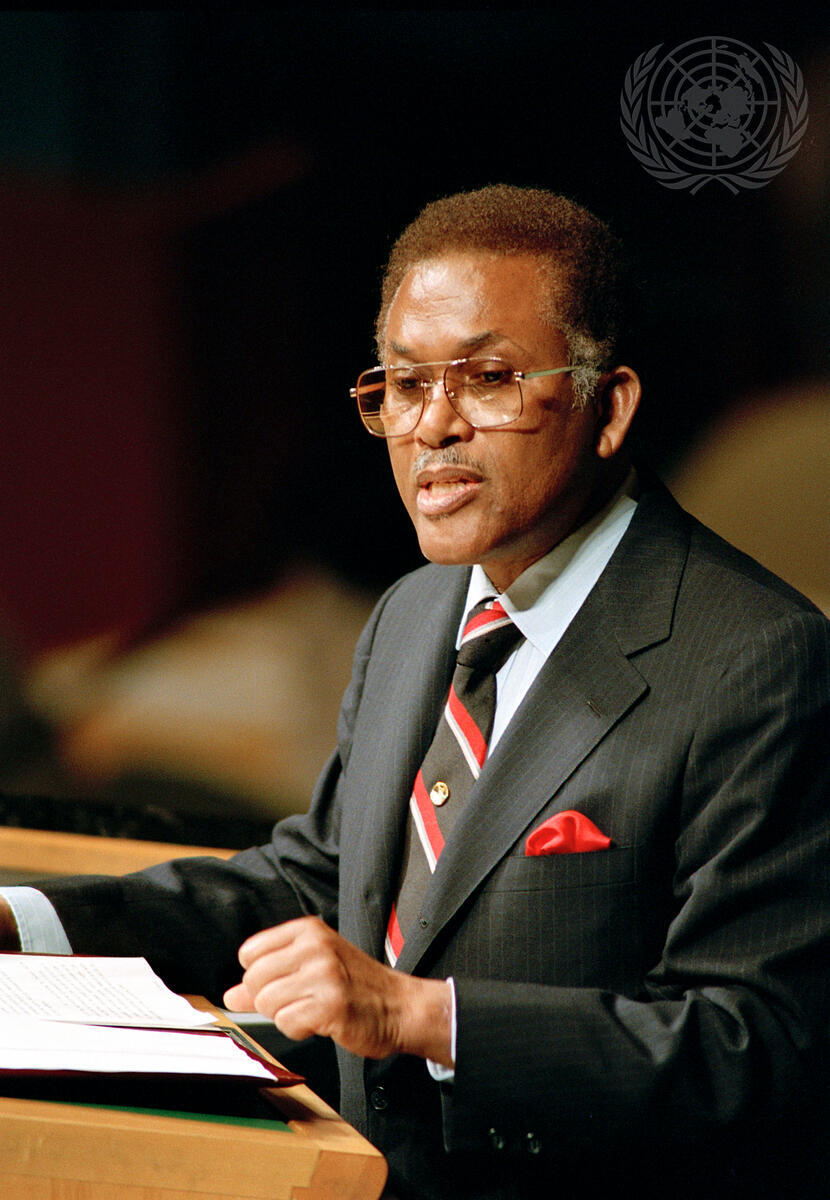
Robinson, 18 May 1998 · two months before Rome
“Failure on the part of statesmen to render their support would be a major disaster in the development of human justice.”7
Four recorded votes, one direction
From 2005 to 2022 the annual resolution passed without a vote. Consensus broke in 2023, and the recorded votes since then trace a clear line. In 2023 Trinidad and Tobago sponsored the text and voted for it; it passed 115 to 6. In 2024 it passed 113 to 10, with Trinidad and Tobago and the United States both in favour. In 2025 the United States voted against. Trinidad and Tobago still voted yes, and the resolution passed 94 to 10. This year Washington voted no again, and Trinidad and Tobago moved from yes to abstention.23451
An abstention is a recorded decision. Governments that wish to avoid a question can stay out of the vote altogether, and dozens did in each of the previous three years: 41 states in 2023, 40 in 2024, 55 in 2025. Trinidad and Tobago was present, and chose not to say yes.345
Report of the International Criminal Court · recorded votes
Washington turned against the resolution in 2025. Trinidad and Tobago stepped back in 2026
From 2005 to 2022 the resolution passed without a vote. Select a year to see the tally and the two positions.2
A/81/L.11
2 Nov. 2026
93
Yes
13
No
36
Abstain
Trinidad and Tobago: Abstain · United States: No1
In 2023 the country's delegate, Devita Abraham, used the same debate to invoke Robinson's warning that the world was on a collision course with its own inhumanity.27 This year the draft resolution circulated on 27 October with 54 sponsors. Belize was the only CARICOM state among them. Trinidad and Tobago was not on the list.20
A week of two firsts
The abstention came five days after another break with precedent. On 28 October Trinidad and Tobago voted against the annual resolution calling for an end to the United States embargo on Cuba. It had abstained when the resolution was first put in 1992 and voted in favour every year since, including 2025. It was the only CARICOM member to vote no. Jamaica, Guyana and Haiti abstained; the other members present voted yes.171819
The Prime Minister defended that vote in the language of freedom. “We cannot demand democracy and free and fair elections for ourselves and remain silent when those freedoms are denied for neighbouring citizens in neighbouring countries,” Kamla Persad-Bissessar told diplomats on 29 October.19 If that is the principle, the International Criminal Court is the institution built for the gravest denials of all: genocide, crimes against humanity and war crimes.
On the Court, no comparable explanation has been given. The Trinidad Express reported on 3 November that the Ministry of Foreign and CARICOM Affairs had yet to make any official statement on the abstention.2 In both votes Trinidad and Tobago moved toward the position of the United States, and in both it departed from a record of more than two decades. The Government may have reasons: concern about the reach of the Court's jurisdiction, about a small state's exposure to American sanctions, or about a security relationship with Washington that has deepened this year. It has not set them out.
Five days · two breaks with precedent
In both votes, the United States voted no
Wednesday 28 October
Ending the US embargo on Cuba
130–17–25
Trinidad and Tobago
No
First time
United States
No
Before: Abstained in 1992; yes every year from 1993 to 2025.1718
Monday 2 November
Report of the International Criminal Court
93–13–36
Trinidad and Tobago
Abstain
First time
United States
No
CARICOM on the Cuba resolution, 28 October
Yes · 7
- The Bahamas
- Barbados
- Belize
- Grenada
- St Kitts and Nevis
- St Vincent and the Grenadines
- Suriname
Abstain · 3
- Jamaica
- Guyana
- Haiti
No · 1
- Trinidad and Tobago
Did not vote · 3
- Antigua and Barbuda
- Dominica
- Saint Lucia
CARICOM positions as reported by CANA/CMC from the UN meeting record.19
A court under sanction
On 9 October the United States imposed sanctions on the International Criminal Court as an institution. They followed designations against thirteen of its judges and prosecutors. “We will ban transactions with this rogue court, cutting off their resources and crippling its ability to operate,” Secretary of State Marco Rubio said. UN Secretary-General António Guterres called the measures a serious blow.131516
Addressing the Assembly on 2 November, President Tomoko Akane said nine of the Court's eighteen judges are now under sanctions “for nothing other than the performance of their independent judicial mandates”. Six states notified their withdrawal from the Rome Statute during the reporting year, and another has since taken steps to leave.14 The Court's own response to the sanctions placed the burden plainly: “Its fate now rests also in the hands of the States that created it.”13
The Court in 2026
Half the bench under sanction
9 of 18 judges are under United States sanctions, President Tomoko Akane told the Assembly.14
Trinidad and Tobago is one of those states, and not in a figurative sense.
Robinson saw this coming
In August 2002, weeks after the Rome Statute entered into force, Robinson issued a statement on what he called “the United States administration's campaign against the International Criminal Court”. The Court, he said, was an institution “we must defend against all attacks in order to ensure the future of our children and of all mankind”.6
Four years earlier he had set out the conditions on which the Court's credibility would rest: a court “unfettered by the reality or perception of subordination to the will of a few states”, which would “never be a reality unless states agree to fund its operations and comply with its orders under all circumstances”.7
Then and now
An institution “we must defend against all attacks in order to ensure the future of our children and of all mankind”.6
A.N.R. Robinson · 23 August 2002
Trinidad and Tobago
2 November 2026
Abstain
“We will ban transactions with this rogue court, cutting off their resources and crippling its ability to operate.”15
Marco Rubio, US Secretary of State · 9 October 2026
Those conditions are the test now facing every State Party, and they describe precisely what a small state stands to lose. Trinidad and Tobago has no navy capable of deterring a major power and no economy large enough to dictate terms. Its security and its standing depend on a system in which rules constrain the strong. The Court is one part of that system, and it is the part this country did most to create.
There are serious arguments about the Court: the reach of its jurisdiction over nationals of states that have not joined it, the pattern of its early cases, its dependence on governments that do not always cooperate. Delegations made those arguments in the General Assembly on 2 November.1 A founding state with concerns is better placed than almost any other to press them inside the system. An unexplained abstention leaves the concerns unstated and the record diminished.
The questions the Ministry must answer
The Ministry of Foreign and CARICOM Affairs owes the country a substantive explanation. What changed in the Government's assessment of the Court between November 2025 and November 2026? Did the sanctions, or any representation from Washington, inform the decision? Does Trinidad and Tobago still support the Court's independence and the cooperation the resolution asked of states? Does the Government intend to remain a State Party to the Rome Statute?
For the Ministry of Foreign and CARICOM Affairs
- 1What changed in the Government's assessment of the Court between November 2025 and November 2026?Awaiting a public answer
- 2Did the sanctions, or any representation from Washington, inform the decision?Awaiting a public answer
- 3Does Trinidad and Tobago still support the Court's independence and the cooperation the resolution asked of states?Awaiting a public answer
- 4Does the Government intend to remain a State Party to the Rome Statute?Awaiting a public answer
The former Foreign Affairs Minister, Dr Amery Browne, now in Opposition, has called the abstention “a devaluation of the legacy and work of ANR Robinson”.2 That legacy belongs to the country rather than to any party. It was begun by a National Alliance for Reconstruction Prime Minister, carried through by UNC and PNM governments, and honoured by the Court itself. An unexplained abstention puts that continuity at risk.
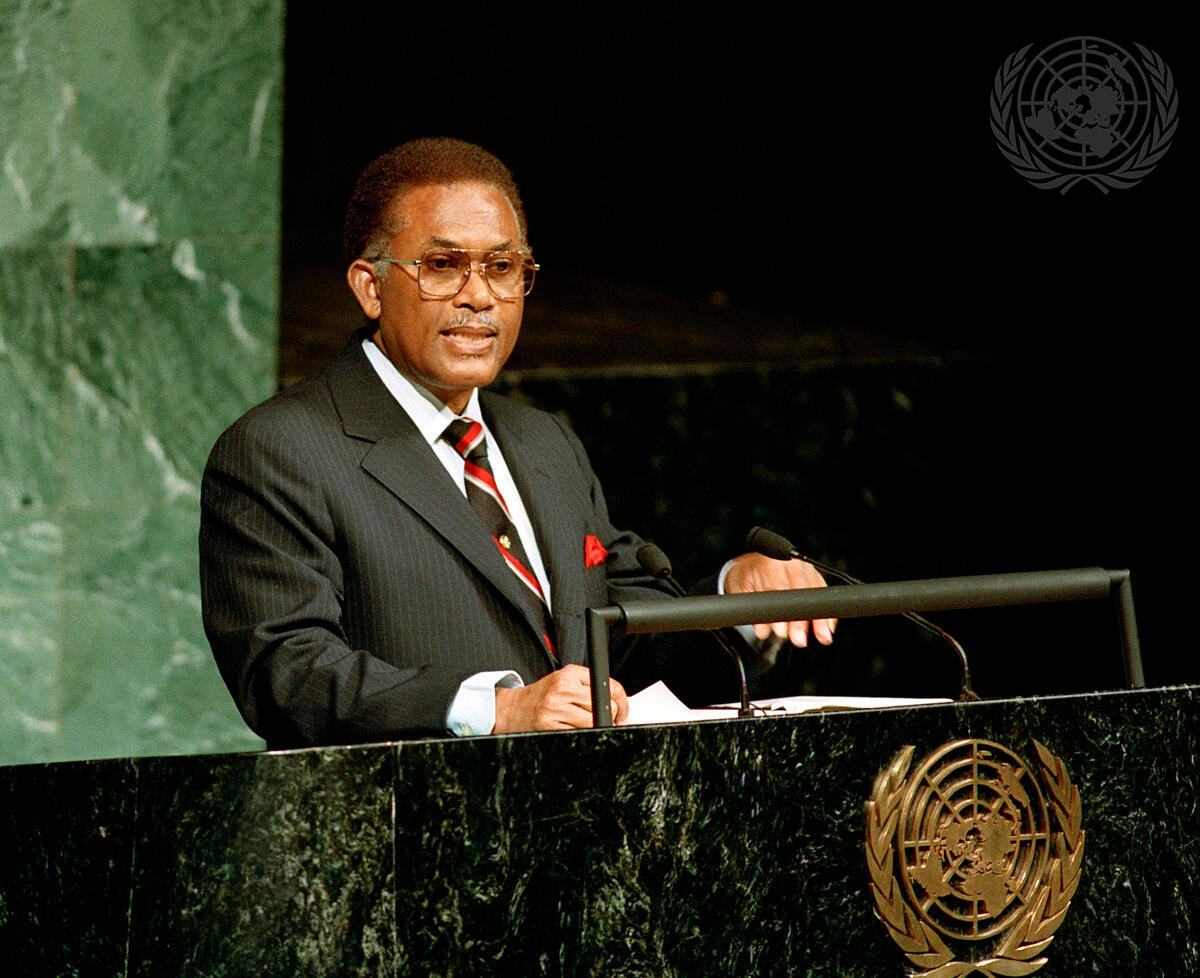
On 4 October 1990 Robinson stood at the General Assembly rostrum and said that “neither a free State nor a free world can long endure without adequate safeguards for the rule of law”. The photograph at the top of this page was taken that day.68
We helped weave justice, accountability and the rule of law into the fabric of the international order. The Court named its first courtroom after Arthur Robinson as a record of what Trinidad and Tobago gave the world. The question now is whether the country that produced him still has the independence and conviction to defend what he helped build.
Citations & source document
- [1]UN record of the 2 November 2026 voteA/81/L.11 adopted 93–13–36; Trinidad and Tobago abstainsRecords adoption of A/81/L.11 by 93 votes to 13, with 36 abstentions; the text condemns threats, attacks and interference against the Court and says it must work without intimidation.
- [2]Trinidad Express on the abstentionA/81/L.11 adopted 93–13–36; Trinidad and Tobago abstainsReports Trinidad and Tobago's first abstention; consensus adoption from 2005 to 2022; sponsorship in 2023; Devita Abraham's 2023 statement; and that the Ministry had yet to make an official statement.
- [3]2023 recorded vote (A/RES/78/6)From sponsor to abstentionAdopted 115–6–31. Trinidad and Tobago is listed as sponsor and voted yes; the United States voted yes; 41 states did not vote.
- [4]2024 recorded vote (A/RES/79/6)From sponsor to abstentionAdopted 113–10–30. Trinidad and Tobago and the United States both voted yes; 40 states did not vote.
- [5]2025 recorded vote (A/RES/80/6)From sponsor to abstentionAdopted 94–10–34. Trinidad and Tobago voted yes; the United States voted no; 55 states did not vote.
- [6]ICC President's tribute to Robinson“The grandfather of the International Criminal Court”Credits Robinson with setting the process in motion in 1989; records his Trust Fund for Victims service and the naming of the Court's first courtroom; quotes his 1990 UN address and his 2002 statement on the US campaign against the Court; calls him the Court's grandfather.
- [7]Robinson's statement of 18 May 1998Robinson on the conditions for a credible courtRobinson's statement before the Rome conference: his 1969 'collision course' warning, the 1989 UN initiative, and the conditions on which the Court's credibility would depend.
- [8]UN Photo of the 1990 addressRobinson at the General AssemblyArchival photograph of A.N.R. Robinson addressing the 45th session of the General Assembly. Credit: UN Photo/John Isaac.
- [9]Ratification and implementation recordSecond State Party; first Caribbean implementing ActSigned 23 March 1999, ratified 6 April 1999 as the second State Party after Senegal; rejected a US bilateral immunity agreement; Judge Hudson-Phillips elected 2003; International Criminal Court Act enacted February 2006.
- [10]General Assembly resolution 44/39Oxford, Woetzel and the 1989 initiativeThe resolution that followed Trinidad and Tobago's initiative, addressing international criminal responsibility for illicit drug trafficking and other transnational crime and the establishment of an international criminal court.
- [11]Coalition for the ICC tributeOxford, Woetzel and the 1989 initiativeRecords the 1989 agenda item, support from all CARICOM states, adoption by consensus, Robinson's 2006 election to the Trust Fund for Victims board and William Pace's assessment.
- [12]Guardian obituaryOxford, Woetzel and the 1989 initiativeTraces Robinson's commitment to a permanent tribunal to Oxford in the 1950s with Robert Woetzel, and their 1972 Foundation for the Establishment of an International Criminal Court.
- [13]ICC statement on US sanctionsThe Court sanctioned as an institutionThe Court's response to the sanctions on the institution, which followed designations against thirteen judges and prosecutors.
- [14]ICC President's 2026 report to the AssemblyThe Court sanctioned as an institutionRecords that nine of eighteen judges are under sanctions and that six states notified withdrawal during the reporting period, with another taking steps since.
- [15]Reuters on the sanctions announcementThe Court sanctioned as an institutionReports Secretary of State Marco Rubio's statement announcing sanctions on the Court as an institution.
- [16]UN News: Secretary-General's responseThe Court sanctioned as an institutionRecords the Secretary-General's condemnation of the sanctions on the Court.
- [17]UN record of the Cuba embargo voteTrinidad and Tobago votes against the Cuba embargo resolutionRecords adoption of A/81/L.5 by 130 votes to 17, with 25 abstentions.
- [18]Trinidad Guardian on the Cuba voteTrinidad and Tobago votes against the Cuba embargo resolutionTrinidad and Tobago opposed the resolution for the first time; it abstained in 1992 and voted in favour every year thereafter, including 2025.
- [19]Prime Minister's explanation of the Cuba voteTrinidad and Tobago votes against the Cuba embargo resolutionReports the Prime Minister's explanation of the Cuba vote and records the CARICOM voting positions.
- [20]Sponsors of draft A/81/L.1154 sponsors; Belize the only CARICOM stateDescribes draft A/81/L.11 as tabled on 27 October with 54 sponsors; Belize the only CARICOM sponsor; Trinidad and Tobago not on the list as circulated.
- [21]Newsday on the path to RomeFrom drug trafficking to the core crimesRecords the 1989 CARICOM-backed initiative, the 1994 International Law Commission draft statute, the shift from drug trafficking to core crimes, and the 1998 and 2002 milestones.
Every document cited above is held on this site, with the key clauses, extracts and findings set out in full and a link to the document of record.
Cite this article
Outlets, researchers and broadcasters may quote this reporting with credit and a link to the original.
Robinson, P. (3 November 2026). "We helped build the International Criminal Court. Now we are tearing at the fabric of our own legacy". PearceRobinson.com. https://pearcerobinson.com/reporting/trinidad-tobago-abstains-icc-resolution-anr-robinson-legacy
Sources
- 1UN Meetings Coverage (GA/12804) — General Assembly condemns threats to International Criminal Court
- 2Trinidad Express — T&T breaks 20-year support for ICC championed by Robinson
- 3UN General Assembly recorded vote (A/78/PV.25) — A/RES/78/6 — Report of the International Criminal Court
- 4UN General Assembly recorded vote (A/79/PV.29) — A/RES/79/6 — Report of the International Criminal Court
- 5UN General Assembly recorded vote (A/80/PV.35) — A/RES/80/6 — Report of the International Criminal Court
- 6International Criminal Court — Judge Sang-Hyun Song, President — Tribute to A.N.R. Robinson at State Ecumenical Service
- 7ICC Legal Tools Database — Statement by H.E. Arthur N.R. Robinson, President of the Republic
- 8UN Photo (UN7681109) — Prime Minister of Trinidad and Tobago addresses General Assembly
- 9Cooperation and Judicial Assistance Database, University of Nottingham — Republic of Trinidad and Tobago — Rome Statute implementation
- 10UN General Assembly — A/RES/44/39 — Establishment of an international criminal court with jurisdiction over such crimes
- 11Coalition for the International Criminal Court — Coalition mourns passing of ICC champion A.N.R. Robinson
- 12The Guardian — Richard Bourne — ANR Robinson obituary
- 13International Criminal Court — The ICC strongly rejects US sanctions against the institution
- 14International Criminal Court — Judge Tomoko Akane, President — Presentation of the Court's annual report to the General Assembly
- 15Reuters — Humeyra Pamuk, Steve Holland and Anthony Deutsch — US imposes sanctions on International Criminal Court, hours after former judge wins Nobel
- 16UN News — 'Serious blow': Guterres condemns new US sanctions on International Criminal Court
- 17UN Meetings Coverage (GA/12801) — General Assembly adopts resolution to lift United States embargo of Cuba
- 18Trinidad Guardian — Kay Marie Fletcher — T&T votes with US against Cuba embargo resolution
- 19CANA News / CMC — PM Persad-Bissessar doubles down on support for UN vote on Cuba
- 20Caribbean Bridges — Julian Rogers — Monday at the UN: a test for Caribbean capitals on the ICC
- 21Trinidad and Tobago Newsday — Delia Chatoor — Pursuit of justice by way of ICC
Independent reporting by Pearce Robinson. Corrections and responses may be submitted here.