National Security
The permit economy: what a closed area does to a block
Seven policing districts. A permit to enter or leave your own street. A $50,000 fine for getting it wrong. The Special Operations Bill’s heaviest costs fall on vendors, shift workers and anyone who talks to a reporter.
The Special Operations Bill 2026 was introduced in the House of Representatives by the Attorney General on 16 September 2026, five months after an almost identical measure — the Law Reform (Zones of Special Operations) Bill — passed the House at 3.32 a.m. on 17 January and was defeated in the Senate ten days later.[6] The second attempt keeps the architecture the Senate rejected: closed areas, cordons, curfews, warrantless search, and a permit regime governing ordinary movement.
The Bill divides Trinidad into six policing districts and makes Tobago the seventh. District 1 is Port of Spain, Diego Martin and San Juan-Laventille. District 2 is Arima and Tunapuna-Piarco.[1] Within any district, the President may declare a closed area by Order, subject to negative resolution — which is to say the Order takes effect immediately and Parliament must move to annul it rather than approve it.[2]
Once an area is closed, a permit is required to enter or leave it. Senior officials, judges, police officers and soldiers on duty are exempt. Everybody else applies to the Head of Special Operations or the Head of Military Assistance, receives a permit subject to whatever conditions are specified, and can have it suspended or cancelled in writing at any time. Failure to hold one, or to comply with a condition attached to one, carries a fine of $50,000 and a year in prison on summary conviction.[3]
Nowhere in the Bill is there a scheme of compensation for loss caused by a lawful cordon, curfew or closure.
Inside a declared closed area
- 7
- Policing districts, Tobago the seventh
- $50,000
- Fine for a permit breach, plus one year
- 0
- Warrants required to search inside the area
Penalties on summary conviction for breaching the permit requirement or a permit condition. Districts are fixed in the Schedule to the Bill and may be amended by the Minister by Order, subject to negative resolution.
Source · Special Operations Bill, 2026, clauses 4, 11–15; Bill Essentials No. 2 of 2026–2027; Trinidad Guardian, 19 September 2026
The vendor is the first casualty
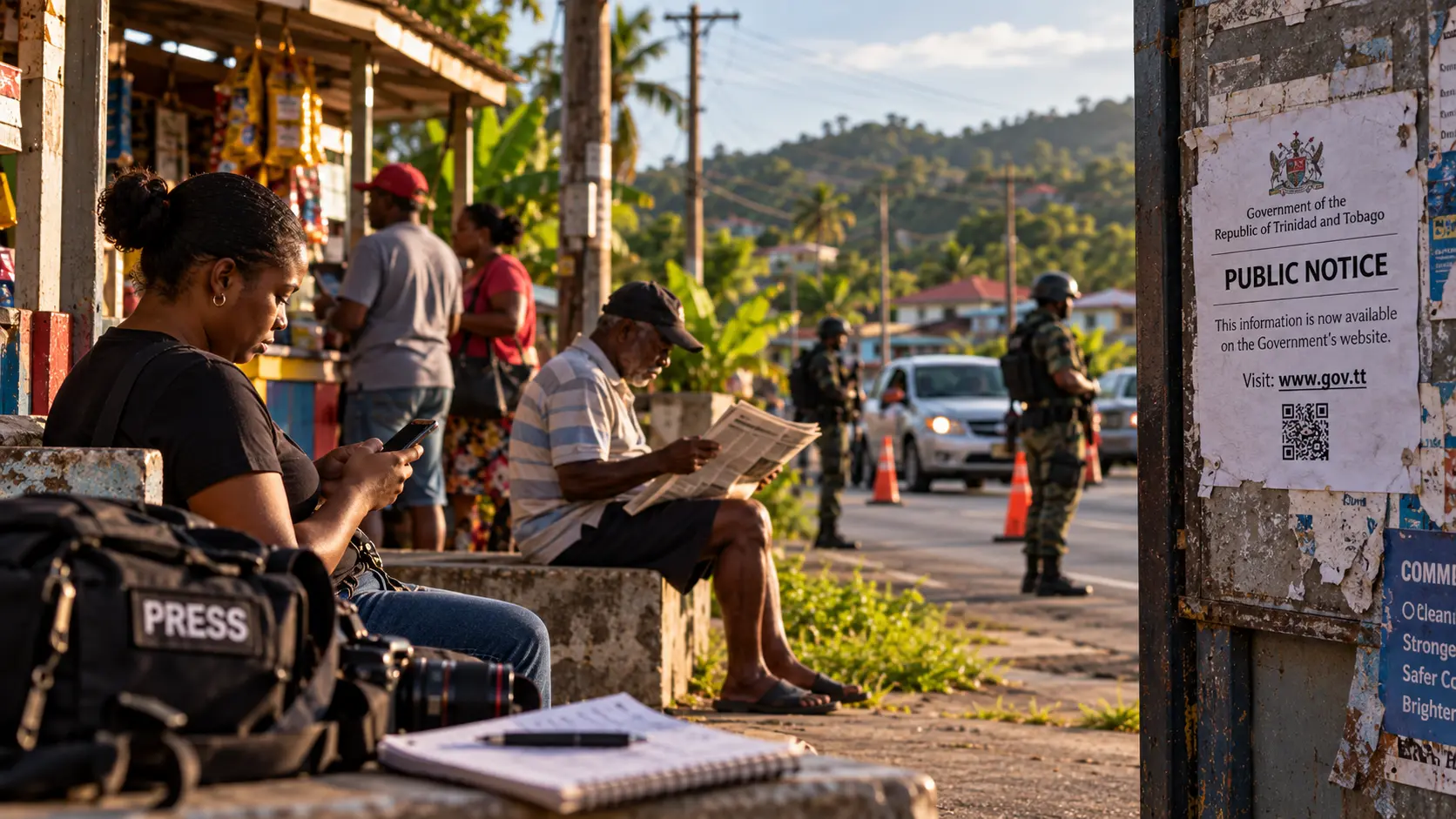
A doubles vendor on a corner inside a cordon does not have a grievance the Bill recognises. Her stock is perishable, her customers are on foot, and her trading day is set by the shift patterns of the people who walk past her. A curfew Order under clause 14 requires people to remain in their premises during specified hours unless they hold a permit.[4] It does not need to run for a week to finish her: three days is enough to write off the stock, and a fortnight is enough to move her regulars to somebody else’s corner permanently.
The same arithmetic runs through every small enterprise inside a boundary drawn on a Gazette notice. The parlour, the barber, the hardware, the maxi route that no longer terminates where it used to. The Confederation of Regional Business Chambers, responding to the January version of this legislation, said exactly this: firms operating in or near designated zones would have to assess the effect on logistics, operating hours, staff mobility, customer access and insurance.[7] Insurance is the quiet one. A business interruption policy generally does not pay out for a loss caused by a lawful act of the State.
Staff and customers need papers
The permit regime does not distinguish between a resident and a worker. A nurse living outside District 1 and working inside it needs a permit to get to the ward. So does the delivery driver, the meter reader, the agency cleaner on a 5 a.m. start, and the customer who wants to buy something. Each permit is discretionary, each carries conditions, and each can be withdrawn without a hearing.
Employers inside a closed area therefore acquire a staffing problem that no employment contract anticipates: their workforce’s right to turn up is held at the discretion of a superintendent. The Bill provides for the Commissioner to issue a blanket permit by Gazette notice to a class or category of persons — the mechanism exists to exempt health workers, utility crews, teachers and the press in a single stroke.[3] Whether he does is a matter of administrative choice, and the Bill imposes no obligation to publish which classes were considered and refused.
Warrantless search, and the notebook problem
Clause 15 allows an officer conducting a special operation in a closed area to search any place, vehicle or person without a warrant, on reasonable suspicion that an offence is being, has been, or is about to be committed, and to seize any article or document of substantial value to an investigation.[5] There are real safeguards on the face of the clause: the owner or occupier must be given the opportunity to observe, women must be searched by women, a list and a receipt must be provided, and tools of lawful trade and legally privileged material may not be seized.
Legal privilege is named. Journalistic material is not.
A reporter’s phone, notebook, recorder and laptop are the working record of every source who spoke on condition of anonymity. Under clause 15 they are seizable by an officer with no judicial authorisation, on a suspicion that is tested afterwards rather than before. The remedy is a constitutional claim — the route the Court of Appeal completed on 29 April 2026, six years after officers walked into a newsroom and removed four flash drives to find out who had talked about a senior officer’s finances. That case ended with a finding of unconstitutionality and $25,000. It also ended in 2026 for a search carried out in 2020.
Sources do not read judgments. They read risk. The people who tell reporters about split contracts, unsigned vouchers and missing stock are clerks, storekeepers and junior officers who live in the districts this Bill names first, and they will price the change in accurately.
What would fix it
Four amendments, none of which weakens an operation against a gang. An express exclusion in clause 15 for journalistic material and confidential source material, mirroring the existing exclusion for legal privilege. A statutory compensation scheme for businesses closed by a lawful cordon or curfew, on the model used for compulsory acquisition. A duty on the Commissioner to publish, in the Gazette, the classes of person granted blanket permits at the moment an area is declared. And affirmative resolution rather than negative for any Order that closes an area or imposes a curfew, so Parliament votes before the barriers go up rather than after.
The Bill’s sponsors say the target is organised crime, and on the Schedule as drafted the districts include the country’s densest commercial and residential ground. The measure of it will not be the arrest figures announced in the first fortnight. It will be whether the woman on the corner is trading three months later, and whether the person who knows where the money went still picks up the phone.
Citations & source document
- [1]Special Operations Bill, 2026 — Clause 4Policing districtsEstablishes policing districts set out in the Schedule; Trinidad divided into districts of one or more municipalities, Tobago a single district. District 1 comprises Port of Spain, Diego Martin and San Juan-Laventille; District 2 comprises Arima and Tunapuna-Piarco.
- [2]Special Operations Bill, 2026 — Clause 11Declaration of a closed areaDeclaration of a closed area by Order of the President, subject to negative resolution; the President must deliver a statement of grounds to the Speaker within seven days.
- [3]Special Operations Bill, 2026 — Clause 12Permits to enter or leave a closed areaNo person may enter or leave a closed area without a permit. Permits are discretionary, may carry conditions, and may be suspended or cancelled. Breach carries $50,000 and one year on summary conviction. The Commissioner may issue a class permit by Gazette notice.
- [4]Special Operations Bill, 2026 — Clause 14CurfewsCurfew imposed by Order of the President, requiring persons to remain in their premises during specified hours unless authorised by permit.
- [5]Special Operations Bill, 2026 — Clause 15Search and seizure without warrantWarrantless search and seizure in a closed area. Tools of lawful trade and items protected by legal privilege are excluded from seizure; journalistic material and confidential source material are not named.
- [6]Bill Essentials No. 2 of 2026–2027 — Legislative historyDeclaration of a closed areaIntroduced 16 September 2026 by the Attorney General. Similar to the Law Reform (Zones of Special Operations) Bill 2026, passed in the House on 17 January 2026 and defeated in the Senate on 27 January 2026.
- [7]Confederation of Regional Business Chambers, January 2026Cordons and permitsBusiness chambers warned that firms in or near designated zones would have to assess effects on logistics, operating hours, staff mobility, customer access and insurance.
Every document cited above is held on this site, with the key clauses, extracts and findings set out in full and a link to the document of record.
Cite this article
Outlets, researchers and broadcasters may quote this reporting with credit and a link to the original.
Robinson, P. (23 September 2026). "The permit economy: what a closed area does to a block". PearceRobinson.com. https://pearcerobinson.com/reporting/permit-economy-closed-areas
Independent reporting by Pearce Robinson. Corrections and responses may be submitted here.