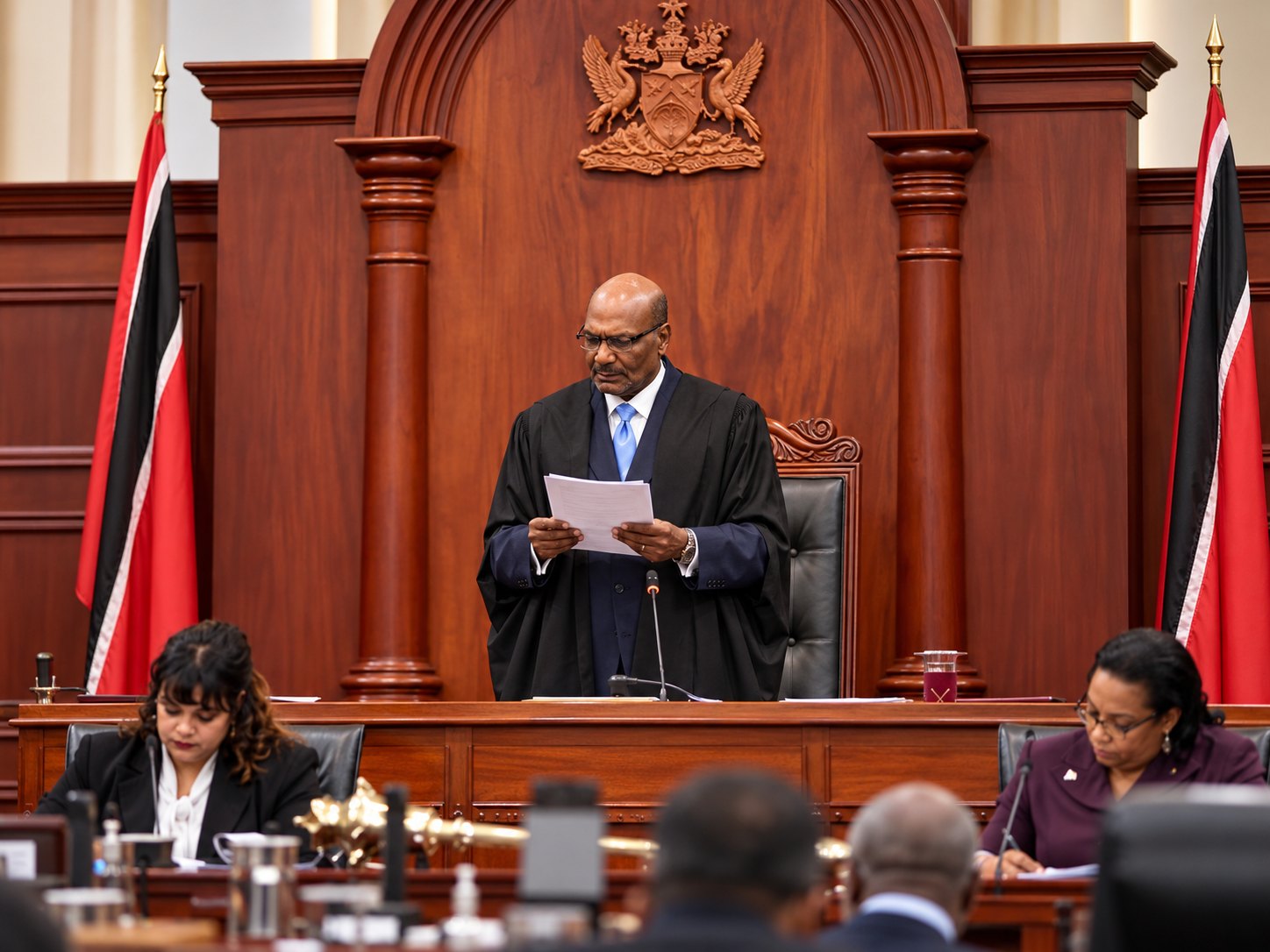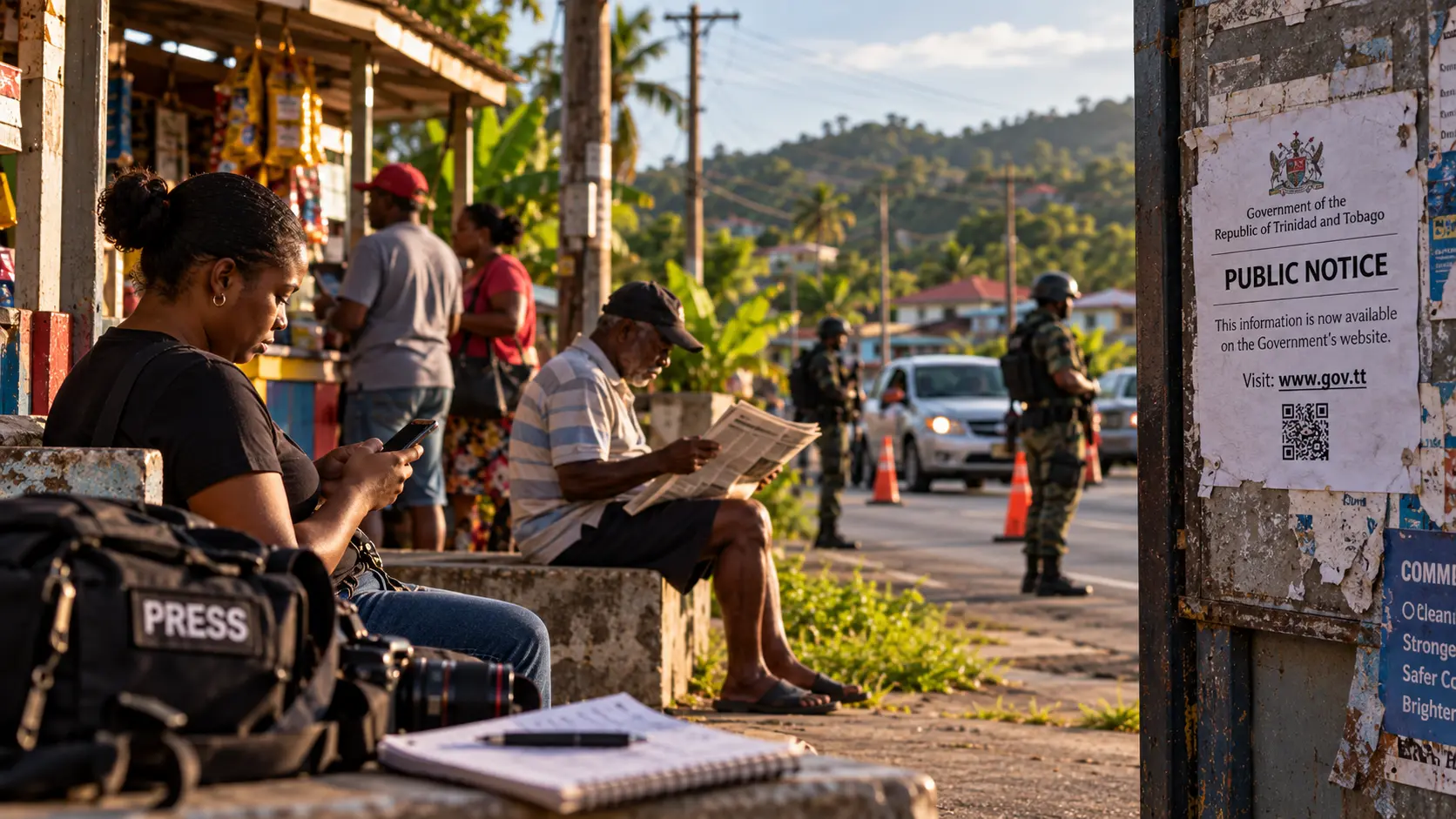
Since the United National Congress returned to government in May 2025, Trinidad and Tobago has moved through a striking series of legal and institutional changes affecting how citizens receive public information, how the State may search and restrict individuals, how journalists protect confidential material, and how billions of dollars in procurement are scrutinised.
In September 2026 alone, Parliament passed a Freedom of Information amendment, the Special Operations Bill and major proposed changes to the public-procurement regime—measures that reach directly into public access to information, policing powers and oversight of public spending.157
These measures followed emergency regulations permitting preventive detention without a criminal charge. Dominic and Genevieve Hadeed were arrested on 24 June; Preventive Detention Orders followed on 27 June. A review tribunal later concluded that continued detention was no longer necessary or expedient in the public interest. The orders were revoked on 23 July, and Gazette notices recording the revocation appeared on 20 August.34
The individual measures are different in purpose, legal foundation and effect. Taken together, however, they raise a question that cannot be answered by reading any one Bill in isolation: is the balance between administrative power, public accountability and the rights of the citizen being materially redrawn?
The rules have changed
Information
Where public notices appear1
State power
Emergency detention and review3
Special operations
Closed areas, searches and sources5
Public money
Exemptions, remedies and challenges7
Timeline · 2025–2026
Power moved through different legal channels
- Government
UNC administration takes office
- Emergency power
State of public emergency proclaimed
- Emergency power
Hadeed arrests followed by preventive-detention orders
- Review
Orders revoked after tribunal review
- Bill
FOI publication amendment passes through Parliament
- Bill
Special Operations Bill passes Senate after tied division
- Bill
Procurement Bill passes Senate after tied division
From the newspaper to the website
The Freedom of Information amendment changes how public authorities may publish statutory statements. Where the legislation required publication through a daily newspaper, the Bill permits the authority to choose between a daily newspaper and a publicly accessible website. It does not remove the right to submit a Freedom of Information request. Government can legitimately point to lower publication costs, speed and digital modernisation. But digital publication and universal access are not the same thing.1
TATT and the Central Statistical Office found working fixed-broadband subscriptions in 75 per cent of urban households and 71 per cent of rural households—not the 83 and 79 per cent figures sometimes repeated as an urban-rural comparison. Eight of Trinidad's fourteen municipalities fell below the national ICT Development Index benchmark. Princes Town, Sangre Grande and Mayaro/Rio Claro had the three lowest municipal scores; in Tobago, St Patrick, St David and St John were the lowest-scoring parishes on that measure.2
For the household without reliable broadband, the pensioner who does not routinely navigate ministry websites, the citizen rationing mobile data, or a community already identified as digitally underserved, moving a guaranteed publication route away from newspapers may reduce a practical avenue of access. The argument is not nostalgic. It is about the chain of device, electricity, data, digital literacy and knowing which website to search before information described as public can actually be found.
Digital divide · Verified figures
Digital does not mean universal
75%
Urban households with fixed broadband
71%
Rural households with fixed broadband
Print route
Government → newspaper → citizen
Website route
Government → website → citizen
Eight of Trinidad’s fourteen municipalities were below the national ICT-development benchmark. The figures describe fixed-broadband subscriptions, not every form of internet use.2
Newspapers are also more than delivery systems for government notices. They are part of the machinery by which government is scrutinised. Removing a recurring category of State publication therefore has an economic dimension in a small media market. That does not create an entitlement to public advertising, and it does not prove that a single policy caused contraction in the press. It does require the State to consider what happens when it is both the maker of publication rules and one of the market's significant advertisers.
From emergency power to ordinary legislation
The Special Operations Bill moves the debate from access to coercive power. It would allow closed areas, permits, cordons and curfews, and warrantless searches and seizures within designated areas on stated statutory grounds. The Government says such tools are necessary against serious and gang-related crime. The Bill also contains procedural, reporting, training and body-camera provisions.5
Emergency powers and the Special Operations framework are not legally identical. The former arose under the Constitution during a declared emergency; the latter was presented as ordinary legislation. The proximity nevertheless matters. The country moved from preventive detention under an exceptional constitutional regime into parliamentary consideration of standing operational powers. The question is not whether one automatically proves the danger of the other. It is what safeguards become necessary when exceptional experience reshapes ordinary law.345
From emergency power to ordinary legislation
Normal legal order
State of emergency
Emergency regulations
Preventive detention
Review and revocation
Special Operations Bill
The regimes are not legally identical. The sequence is the constitutional context.3
For journalism, the omission is precise. Clause 15 expressly protects items covered by legal privilege. No comparable express protection for confidential journalistic material or source-identifying information appears in the Bill. That does not establish that journalists have no protection elsewhere in law. It means that a reporter's device, notes and source trail are not given the same explicit protection in this text.6
Journalistic sources
What a device can reveal
Expressly protected in Clause 15.
No comparable express protection identified in the Bill.6
Who watches the public money?
The procurement changes concern something less visible in daily life but just as consequential: control of the public purse. The Bill proposes broader exemptions, including energy and national security; limits specified remedies available to the Office of Procurement Regulation after certain investigations; raises thresholds for procurement outside the Act; shortens the standstill period; and permits costs in some challenge proceedings.7
The Government's argument is that the existing system creates rigidity and delay, holding up public programmes and energy projects while disadvantaging smaller contractors. Delay can impose a real public cost. But procurement law is also designed to create friction before money is committed—publication, competition, review and an opportunity to challenge.
The difference is practical. In April, the OPR directed the Housing Development Corporation to hold the award of TT$3.4 billion in contracts while it reviewed the procurement record. That intervention did not establish wrongdoing. It demonstrated what it means for a regulator to act before an award becomes a completed fact. Under the new Clause 5 framework, specified findings after a Part IV investigation would be advisory and non-binding.8
The Trinidad and Tobago Transparency Institute asked the Government to pause the measure, warning that broader exemptions and reduced regulatory intervention could weaken independent oversight. That is an attributed policy judgment, not a court's finding that the Bill is unlawful. Its force comes from the cumulative question: what remains of effective scrutiny when more spending sits outside ordinary rules, the time to challenge is shorter and some regulatory remedies are narrowed?9
Who watches the public money?
Office of Procurement Regulation
Independent oversight above the process
The issue is exposure to scrutiny, not an assertion that improper procurement occurred.7
These are not identical laws. One concerns dissemination of public information. Another concerns police and military operations. Another governs expenditure. But each changes a point at which the citizen meets State power: the right to know, security from disproportionate interference, a journalist's ability to protect a source, and the mechanisms through which public spending may be challenged before the money is committed.
The burdens will not fall evenly. A household with reliable broadband can find a notice online. A resident in an underserved district may not. A large corporation can absorb the cost of contesting a procurement more readily than a small contractor. A major newsroom may have lawyers and secure systems; an independent reporter working from a phone and laptop may not. A citizen with resources can pursue executive action through successive courts. Many others cannot.
Who feels it most?
A national rule can have unequal effects
Rural household
A digital-only route may require connectivity, data and knowing where to search.
Low-income citizen
Data, transport and legal costs change whether a right can be exercised.
Journalist
A device search can expose notes, contacts and source identity.
Small contractor
Shorter challenge periods and possible costs alter the risk of objecting.
Ordinary citizen
Review often requires time, knowledge and legal resources.
The question is no longer simply what each measure changes. It is what happens to the balance between the citizen and the State when all of those changes are considered together.
The balance, viewed five ways
Reduced mandatory publication channels
Newspaper or publicly accessible website
The question is no longer simply what each measure changes. It is what happens to the balance between the citizen and the State when all of those changes are considered together.
Citations & source document
- [1]Freedom of Information amendmentNewspaper or publicly accessible websiteThe publication-channel amendment and its parliamentary status.
- [2]National Digital Inclusion Survey 2021Fixed broadband: 75 per cent urban, 71 per cent ruralVerified fixed-broadband and underserved-area findings.
- [3]2026 emergency frameworkA distinct constitutional regimeThe constitutional framework is distinct from ordinary legislation.
- [4]Hadeed preventive-detention sequenceArrest, orders, review and revocationArrest, PDO, tribunal finding, revocation and Gazette dates kept separate.
- [5]Special Operations Bill, 2026Closed areas and operational powersClosed-area powers and parliamentary passage.
- [6]Clause 15 and confidential sourcesExpress privilege, no comparable express source clauseExpress legal privilege contrasted with the absence of a comparable express journalistic-material clause.
- [7]Procurement Amendment Bill, 2026Exemptions, remedies, thresholds and challengesExemptions, remedies, thresholds, challenge costs and standstill period.
- [8]OPR's HDC interventionA regulator acting before awardOfficial statement recording the hold pending review.
- [9]Transparency Institute positionTransparency Institute asked Government to pauseAttributed institutional concerns about the Bill.
Every document cited above is held on this site, with the key clauses, extracts and findings set out in full and a link to the document of record.
Cite this article
Outlets, researchers and broadcasters may quote this reporting with credit and a link to the original.
Robinson, P. (29 September 2026). "A new balance of power: how recent Bills and emergency powers are changing rights, press freedom and public oversight in Trinidad and Tobago". PearceRobinson.com. https://pearcerobinson.com/reporting/new-balance-power-rights-press-freedom-public-oversight
Sources
- 1Parliament of Trinidad and Tobago — Freedom of Information (Amendment) Bill, 2026
- 2TATT and Central Statistical Office — National Digital Inclusion Survey 2021
- 3Parliament of Trinidad and Tobago — State of public emergency record
- 4Gazette and contemporaneous court reporting — Hadeed preventive-detention record
- 5Parliament of Trinidad and Tobago — Special Operations Bill, 2026
- 6Bill text and Media Association concerns — Special Operations Bill — journalistic material
- 7Parliament of Trinidad and Tobago — Public Procurement Amendment Bill, 2026
- 8Office of Procurement Regulation — OPR statement on TT$3.4bn HDC procurement
- 9Trinidad and Tobago Transparency Institute, reported by Trinidad Guardian — Transparency Institute warning
Independent reporting by Pearce Robinson. Corrections and responses may be submitted here.