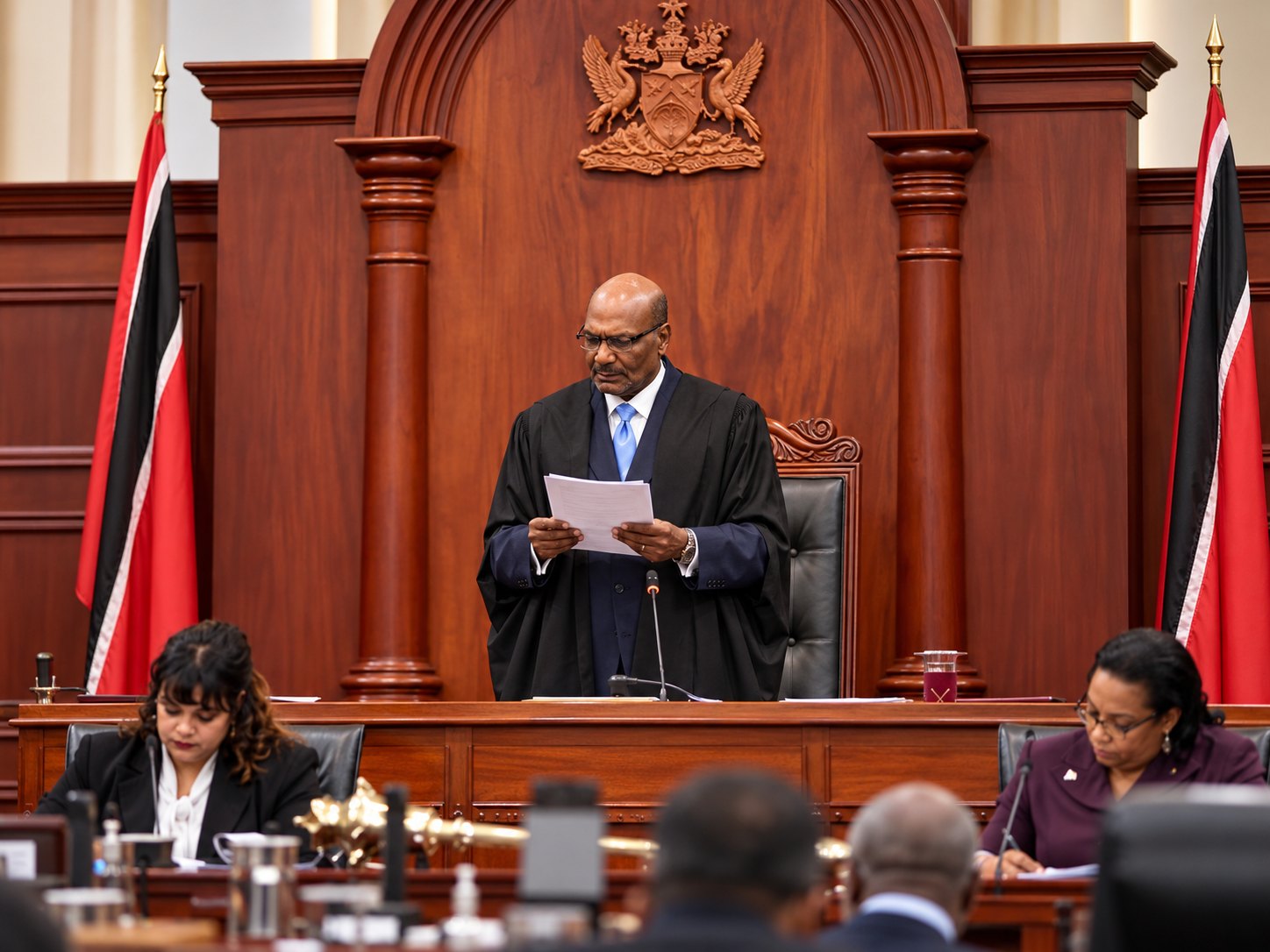
Within five days, two major Government Bills passed Trinidad and Tobago's Senate by exactly the same route. On the Special Operations Bill, all 15 Government senators voted in favour while the six Opposition and nine Independent senators voted against. The result was 15–15. Senate President Wade Mark then exercised his casting vote for the Ayes, producing a 16–15 result and passing the Bill at third reading. On 28 September, the Public Procurement and Disposal of Public Property (Amendment) Bill reached the same deadlock: 15 Government senators for, the combined 15 Opposition and Independent senators against. Mark again voted with the Government and the Bill passed 16–15.123
What actually happened
24 September 2026 · Senate
Special Operations Bill1
- Deadlock15 – 15
- President's casting vote+1 Aye
- Passed16 – 15
Ayes: 15 Government. Noes: 6 Opposition and 9 Independent senators.3
View source28 September 2026 · Senate
Public Procurement Amendment2
- Deadlock15 – 15
- President's casting vote+1 Aye
- Passed16 – 15
Ayes: 15 Government. Noes: 6 Opposition and 9 Independent senators.13
View sourceThose votes have produced a serious parliamentary dispute, but the basic legal position is not difficult. Standing Order 54(2) says that the President of the Senate does not ordinarily vote, but where the votes are equally divided he “shall have and exercise a casting vote”. Mark therefore had the authority to vote when the Senate divided 15–15. The Standing Order does not expressly tell him whether that vote must be cast for the Ayes or the Noes.4
How can one vote decide a Bill?
Ayes · 15
15 Government
Noes · 15
6 Opposition (solid grey) · 9 Independent (outlined)
Written rule
The President does not ordinarily vote. When votes are equally divided, Standing Order 54(2) requires a casting vote.4
Interpretation
The rule says he must vote. It does not expressly say how he must vote. That distinction is the foundation of this dispute.
The controversy begins with what the rest of Trinidad and Tobago's parliamentary rules say about how such gaps are handled. Standing Order 2 instructs the President to be guided by the Senate's established practices and previous presidential rulings. Where the Standing Orders do not provide an answer, the Senate is directed to the usage and practice of the United Kingdom House of Commons, so far as applicable and consistent with local practice. Parliament itself says its Standing Orders are not a complete code and that significant parts of parliamentary procedure are governed by custom and precedent. Its official glossary defines a casting vote as the deciding vote used to resolve a tie and adds that the presiding officer “traditionally votes so as to maintain the status quo”.45
The written rules
Standing Orders of the Senate · Extract
54.(2) The President does not ordinarily vote; where the votes are equally divided, the President “shall have and exercise a casting vote”.
View sourceQuoted words are the text of the Standing Order; the rest summarises it.4
Legal power: when the Senate is tied, the President has a casting vote.
The dispute: what principles should guide that vote?
What Westminster practice actually says
The British convention is often reduced to the claim that a Speaker must always vote no. That is incorrect. Erskine May, the principal authority on Westminster parliamentary procedure, identifies three guiding principles developed through centuries of precedent: where possible, the chair should vote to permit further discussion; where no further discussion is possible, a decision should not be taken without a majority; and a casting vote on an amendment should ordinarily leave the Bill in its existing form. The purpose is not to favour Government or Opposition, but to avoid having the presiding officer personally create a final substantive outcome which the chamber itself has failed to support by a majority.6
What the written rule allows
A tied vote activates the President's casting vote.4
View sourceLegal authority
What Westminster convention expects
- 1. Where possible, allow further discussion.
- 2. Where no further discussion is possible, do not make a final decision without a majority.
- 3. On a tied amendment, preserve the existing text.6
Parliamentary restraint
The best-known precedent is Speaker John Evelyn Denison's ruling in 1861. The House of Commons divided equally on the third reading of the Church Rates Abolition Bill. Denison voted against the Bill, explaining in substance that a change in the law should be made by a majority of the House rather than by the single vote of its presiding officer. Erskine May continues to cite that decision as one of the authorities for the principle that, where no further discussion is possible, a final decision should not be taken without a majority.6
House of Commons · 1861
Church Rates Abolition Bill
Third reading · Votes equal
Speaker Denison → No
His reasoning, in substance: a change in the law should be supported by a majority of the House, not created by the presiding officer's single vote.6
The precedent that developed into the Westminster convention — not a claim that the two Parliaments are legally identical.
That precedent is particularly relevant because Mark's recent votes were not merely decisions about whether debate should continue. The Special Operations Bill had reached its final Senate vote. The Procurement amendment had also reached its decisive passage vote. In each case the senators voting were equally divided until the President of the Senate supplied the vote that produced passage.
Trinidad and Tobago has its own precedents
This is not simply a British convention being imported into a Trinidad and Tobago controversy. The country's own parliamentary record contains repeated examples of presiding officers applying the same principle. In April 2022, after a tied Senate division, the then Senate President expressly referred to Standing Order 54(2) and cited the three Erskine May principles before exercising the casting vote to preserve the existing position: “I vote to maintain the status quo.”7
There is an even more pointed example from May 2023. Wade Mark was then an Opposition senator and had proposed amendments to a motion on parliamentary autonomy. The vote on his amendments was 15–15. Parliament's own official record states that the President of the Senate exercised the casting vote against Mark's amendments “in accordance with established practice.” The original motion was subsequently defeated 12–18.8
Then, after becoming Senate President, Mark himself repeatedly relied on the same principle. During consideration of the Children's Life Fund amendment legislation on 23 June 2025, Government senators and the combined Opposition and Independent benches produced three separate 15–15 votes on proposed amendments. On one, Mark said: “I secure and favour the status quo.” On another, he said: “I vote to secure the status quo.” The amendments failed and the existing Bill remained unchanged. Parliament's Hansard records those words directly.9
There is an important legal distinction here: those 2025 votes concerned amendments rather than third reading. Under the Westminster approach, maintaining the existing wording of a Bill when an amendment is tied is one specific application of the casting-vote convention. It does not automatically determine how every later tie must be resolved. But it establishes that Mark himself had previously recognised preservation of the status quo as a principle guiding the use of his casting vote.
Trinidad and Tobago's casting-vote record
Casting vote against his amendments “in accordance with established practice”
Parliament records a 15–15 tie on Mark's parliamentary-autonomy amendments.8
View sourceJune 2025
15–15
“I vote to secure the status quo.”
Wade Mark · Senate Hansard, 23 June 20259
View source15 months
September 2026
15–15
“no settled practice in this Parliament”
Casting vote for passage · Trinidad Guardian3
View sourceWhat changed?
The 2025 votes concerned amendments; the 2026 votes were final passage. The evidence and competing explanations follow.
What changed in September 2026?
During the Special Operations Bill proceedings on 24 September 2026, Mark took a different position. When the final vote produced the 15–15 tie, he told senators that his research showed there was “no settled practice in this Parliament” on the status quo and casting vote. He said he would make his research available at an appropriate time and then voted with the Ayes. The Bill passed 16–15. Mark later declined to expand publicly on his reasoning, saying his explanation belonged in the parliamentary record and that he did not want to compromise the office he held.3
The same issue arose again four days later on the Procurement amendment. The Government again had 15 votes. The six Opposition and nine Independent senators again combined for 15 against. Mark again cast the deciding vote and the Government Bill passed.213
The Government's defence is clear. Constitutional affairs scholar Hamid Ghany has argued that there is no written rule requiring the presiding officer to cast a tie-breaking vote in a particular direction and that Trinidad and Tobago's own history prevents the status-quo principle from being treated as an unbroken local rule. Government Senate Leader Darrell Allahar has also argued that the Constitution cannot sensibly be interpreted to mean that an elected Government always requires the support or abstention of at least one Independent senator to pass ordinary legislation.10
That argument addresses the President's legal discretion. It does not dispose of the separate question of parliamentary convention. St Lucia House Speaker Claudius Francis, commenting on the dispute, drew precisely that distinction: he considered Mark's action lawful under the written rules while saying it departed from the established parliamentary convention governing casting votes.10
What about Bridgid Annisette-George?
Former House Speaker Bridgid Annisette-George has been brought into the debate because she used casting votes during tied divisions in 2017. Ghany argues that those decisions demonstrate that Trinidad and Tobago cannot now claim an uninterrupted practice requiring the chair always to preserve the status quo. Parliamentary records confirm that Annisette-George used her casting vote on several occasions, including three times on 8 September 2017.14
Annisette-George rejects the comparison. Her position is that her casting votes concerned procedural questions—whether proceedings should continue, whether amendments should be considered or whether the House should adjourn—and did not themselves enact substantive legislation. Former House Speaker Nizam Mohammed has made the same distinction, arguing that those votes permitted or delayed further consideration rather than finally passing, defeating or amending legislation. On 15 March 2017, Annisette-George herself expressly said during a tied division: “I have to vote in favour of the status quo.”1115
That distinction closely tracks the Westminster rule. A casting vote may properly permit further discussion because Parliament retains another opportunity to decide the substantive issue. A final third-reading vote is different: once passed, the chamber has approved the Bill. Whether Annisette-George's 2017 decisions are enough to establish that Trinidad and Tobago has no settled convention remains disputed. What the record does show is that her cases were not factually identical to Mark's two September 2026 third-reading votes.
The precedent dispute
2017 — Annisette-George
- Adjournment
- Further consideration
- Procedural decision
Categories as described by Annisette-George and Nizam Mohammed.15
View sourceIs voting to continue or adjourn proceedings equivalent to casting the decisive vote at final passage?
Why third reading matters
- 1. First readingIntroduction
- 2. Second readingDebate on principle
- 3. CommitteeDetailed examination
- 4. Third readingFinal approval by the chamber
A casting vote at third reading raises a different issue from one that simply allows debate or consideration to continue: after third reading there is no further opportunity in that chamber to decide the question.
The Independent bench cannot simply be written out
The political arithmetic also deserves attention. On both Bills, the Government did not secure the support of a single Opposition or Independent senator at the decisive vote. That does not give the Independent bench a veto, nor does their opposition establish that either Bill was substantively wrong. It does, however, mean that the Government's 15 voting senators could not produce a majority without the Senate President's intervention.
The question is particularly significant because the casting vote belongs to the presiding officer, not to an additional ordinary Government senator. Parliament describes the Senate President as the officer who presides, interprets the Standing Orders and regulates business where the rules do not otherwise provide. Mark also has an extensive political history: Parliament records that he served for decades as a UNC senator, minister and Leader of Opposition Business before becoming Senate President in May 2025. A political history does not disqualify a presiding officer; Westminster presiding officers commonly emerge from party politics. The institutional expectation is that the chair's conduct once appointed should be judged by the requirements of the office rather than previous party allegiance.12
Who is the President of the Senate supposed to represent?
The chair
- Presides over debate
- Interprets Standing Orders
- Maintains order
- Exercises the casting vote when required
A political past is normal. Impartial conduct in the chair is the institutional expectation.12
When 15 Government votes meet 15 Opposition and Independent votes, should the presiding officer's casting vote function as an additional Government vote? This is a question, not a conclusion.
This is why the issue cannot be reduced to whether someone supports Wade Mark, the UNC, the Special Operations Act or the Procurement amendments. The precedent created now is available to future governments and future presiding officers. If the accepted position becomes that the chair may use a casting vote to enact substantive Government legislation whenever the Government's 15 votes are matched by 15 Opposition and Independent votes, that becomes part of the country's parliamentary practice unless subsequently rejected, qualified or changed.
If the vote is tied, what happens?
The Senate votes. Is it a tie?
Westminster practice — not a substitute for Trinidad and Tobago's written law
Test the convention
An exercise in procedure, not a poll. The chamber is tied: what does Westminster practice usually suggest?
A tie on whether to continue considering a Bill.
A tie on an amendment to a Bill's wording.
A tie at third reading of a Bill that would change the law. (Commons, 1861)
A separate issue: Mark's EMBA
Questions have also resurfaced about Mark's Executive MBA from the Arthur Lok Jack Graduate School of Business. Those should not be confused with the present parliamentary dispute. Parliament's official biography records the qualification, and the available evidence does not support describing the programme simply as unaccredited or the degree as invalid. There was a separate public controversy in 2013 concerning the arrangements under which Mark completed aspects of the programme, but no authoritative evidence located for this article establishes that the qualification was revoked.12
The casting-vote controversy does not require that side issue to establish the central facts. Standing Order 54 gives Wade Mark a casting vote. Standing Order 2 directs the Senate toward its own precedent and, where necessary, Westminster usage. Erskine May says a final substantive decision should ordinarily require a majority. Trinidad and Tobago presiding officers have applied that principle before. Parliament itself described a 2023 casting vote against amendments proposed by Mark as being exercised “in accordance with established practice”. Mark himself invoked the status quo repeatedly in 2025. In September 2026, he declared that there was no settled practice and used his casting vote to pass two Government Bills that had each produced a 15–15 division.4689
One casting vote did not merely break a tie. It determined whether the Bill passed the Senate.
Today it benefits one Government.
The precedent will outlive that Government.
When a chamber cannot produce a majority for substantive legislative change, should its presiding officer supply it?
The unresolved question is therefore not whether the Senate President had the power to vote. The written rules establish that he did. It is whether a Westminster-derived Parliament should allow its presiding officer's single casting vote to become the vote that makes substantive law when the senators themselves have failed to produce a majority—and what precedent Trinidad and Tobago now intends to follow the next time the chamber divides 15–15.
The question is bigger than one President, one Government or two Bills.
What rule should govern the casting vote the next time Trinidad and Tobago's Senate divides 15–15?
Citations & source document
- [1]Special Operations Bill — Senate voteSpecial Operations Bill: 15–15, then 16–15Official 16–15 third-reading result.
- [2]Procurement amendment — Senate voteProcurement amendment: 15–15, then 16–15Official 16–15 result.
- [3]September 2026 divisions and ruling“No settled practice”Bloc breakdown and the President's statement, as reported.
- [4]Senate Standing Orders 2 and 54(2)The power and the guideThe written power and the direction to practice and precedent.
- [5]Parliament's procedural guidanceNot a complete codeStanding Orders are not a complete code; the status-quo tradition.
- [6]Erskine May — casting voteThree principles and the Denison rulingThe three principles and the 1861 Denison ruling.
- [7]Senate, April 2022Erskine May expressly appliedErskine May principles expressly applied.
- [8]Senate, May 2023“In accordance with established practice”Casting vote against Mark's amendments “in accordance with established practice”.
- [9]Senate Hansard, 23 June 2025“I vote to secure the status quo”“I vote to secure the status quo.”
- [10]Competing positionsLegal discretion and conventionGhany, Allahar and Francis, attributed.
- [11]The 2017 precedentsThe precedent disputeAnnisette-George's casting votes and the procedural distinction.
- [13]Guardian: Mark steps in againProcurement amendment: 15–15, then 16–15Contemporary report of the second tie.
- [14]House Hansard, 8 September 2017The precedent disputeThree 17–17 divisions and procedural casting votes.
- [15]Annisette-George's responseThe precedent disputeHer position that the 2017 votes were procedural.
- [12]Official biography of the Senate PresidentSenate President since May 2025Career, election as President and qualifications.
Every document cited above is held on this site, with the key clauses, extracts and findings set out in full and a link to the document of record.
Cite this article
Outlets, researchers and broadcasters may quote this reporting with credit and a link to the original.
Robinson, P. (30 September 2026). "When the Senate tied 15–15, Wade Mark cast the vote that passed two Government Bills". PearceRobinson.com. https://pearcerobinson.com/reporting/senate-tied-15-15-wade-mark-casting-vote
Sources
- 1Parliament of Trinidad and Tobago — The Special Operations Bill, 2026 — Senate third reading
- 2Parliament of Trinidad and Tobago — Public Procurement and Disposal of Public Property (Amendment) Bill, 2026 — Senate third reading
- 3Trinidad Guardian — Senate divisions on the Special Operations and Procurement Bills
- 4Parliament of Trinidad and Tobago — Standing Orders of the Senate — SO 2 and SO 54(2)
- 5Parliament of Trinidad and Tobago — Parliamentary procedure and glossary: casting vote
- 6UK Parliament — Erskine May — Casting vote of the Speaker
- 7Parliament of Trinidad and Tobago — Senate Hansard — tied division
- 8Parliament of Trinidad and Tobago — Senate record — parliamentary autonomy motion
- 9Parliament of Trinidad and Tobago — Senate Hansard — Children's Life Fund amendments
- 10Trinidad Guardian — Competing positions on the casting vote
- 11Parliament of Trinidad and Tobago — House of Representatives Hansard
- 12Trinidad Guardian — Mark steps in again
- 13Parliament of Trinidad and Tobago — House of Representatives Hansard
- 14Trinidad Express — Former Speaker: No breach by my 2017 vote
Independent reporting by Pearce Robinson. Corrections and responses may be submitted here.