Caribbean Affairs · Analysis
Mia Mottley’s bigger argument: the global financial system is pricing vulnerability backwards
Barbados is trying to turn the cost of vulnerability into a case for cheaper, longer and more useful finance. The test is whether the architecture changes—not merely its language.
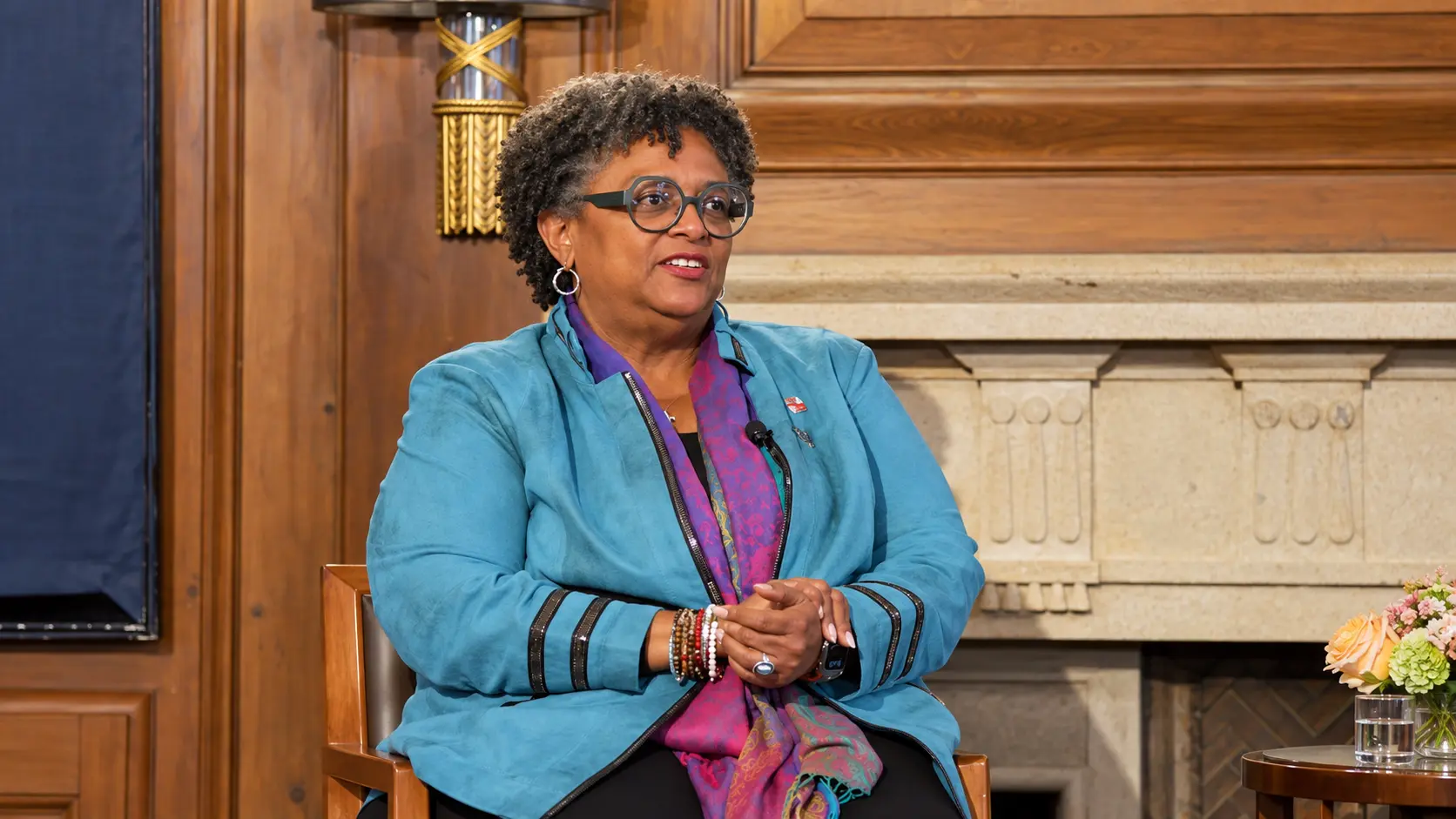
When Mia Mottley sat down at the Council on Foreign Relations in New York on 23 September, the conversation was ostensibly about the pressures confronting climate-vulnerable and developing countries. Beneath the language of development finance, resilience and institutional reform was a more consequential argument: the architecture governing the global economy no longer adequately reflects where risk originates, who bears it or who is given the financial capacity to escape it.[1]
That distinction matters. For decades, the international development conversation has often treated vulnerable states principally as recipients—countries to which assistance, concessional lending or disaster relief should occasionally flow. Mottley’s argument is different. Small developing economies can be fiscally disciplined, democratically stable and economically functional, yet still confront borrowing costs and insurance pressures determined heavily by geography, climate exposure, scale and shocks they did little to create. The countries requiring the greatest investment in resilience can therefore face some of the most restrictive conditions for financing it.
This is why the Bridgetown Initiative has always been more ambitious than a request for additional climate money. Conceived in 2022 and now developed through its third iteration, it challenges the plumbing of international finance: how multilateral development banks deploy their balance sheets; what determines access to concessional capital; how long development loans should run; what happens to debt service when catastrophe strikes; how private capital is de-risked; and whether income per capita is an adequate measure of vulnerability.[2]
Mottley is pushing that argument into implementation. At CFR, she said Barbados was preparing its first debt-for-social swap, involving several banks and designed to redirect financial savings into social development. It was not a new initiative unveiled in New York: Barbadian officials had discussed the proposed transaction publicly for months. The significance lies less in novelty than in the policy logic behind it. Sovereign debt is ordinarily treated as a liability to be serviced. Barbados is asking whether its structure can also become an instrument of development—refinancing obligations and directing savings towards health and other public goods.[3]
That approach follows an earlier debt-for-climate transaction completed in 2024, but the two should not be confused. The climate swap supported water and resilience investment; the proposed social swap has been described by the Government in relation to health and non-communicable diseases. Both use the terms of sovereign finance to create fiscal space, but they are separate transactions.[4]
Barbados is not making these arguments from outside the international financial system. In June 2025, the International Monetary Fund concluded the fifth and final reviews of the country’s Extended Fund Facility and Resilience and Sustainability Facility. The Fund said public debt had continued to decline and described the programme as supporting fiscal sustainability, growth and climate resilience. Barbados therefore occupies an unusual position: a borrower operating within orthodox multilateral frameworks while advocating changes to those frameworks.[5]
There is also a geopolitical dimension. Small states constitute a significant bloc within the international system but individually possess limited economic and military weight. Their influence depends disproportionately on coalition building, institutional entrepreneurship and the ability to convert moral arguments into technically credible proposals. Mottley’s diplomacy has increasingly operated on precisely that terrain. The objective is not to pretend that Barbados can command the international financial order, but to demonstrate that a small state can help shape the vocabulary through which that order discusses debt, climate vulnerability and development.
One of the most revealing moments came when Mottley was asked why she had not sought to become the next United Nations Secretary-General. ‘I have a country to run and a region to take care of,’ she replied. She added that she was uncertain whether the world wanted someone whose ‘tongue is as heavy as mine’. The remark was characteristically colourful, but strategically more interesting than it first appeared. It located her international profile within a Caribbean mandate rather than presenting global office as its culmination.[6]
That matters because the Caribbean has historically been discussed internationally more often as an object of great-power policy than as a source of global policy design. Climate change, correspondent banking, debt, energy dependence, food insecurity, migration and exposure to external shocks have repeatedly demonstrated the limitations of sovereignty when sovereignty is unsupported by scale. Mottley’s answer has been to internationalise those constraints: not by denying domestic responsibility, but by insisting that responsible domestic policy cannot by itself overcome structural features of the global economy.
The test is implementation. Reforming multilateral development banks is painstaking. Wealthier governments face their own fiscal and political constraints. Creditors will not abandon risk assessments simply because vulnerable states regard them as inequitable. Private capital requires returns, and new financial instruments can become exercises in complexity if they do not ultimately produce cheaper capital, greater investment and measurable improvements in resilience. The Bridgetown agenda succeeds or fails on whether its innovations migrate from conference halls into routine sovereign finance.
That is what made the CFR discussion more consequential than another appearance by a Caribbean leader during UN week. It placed the region inside a debate normally dominated by finance ministries, central banks, development institutions and major economic powers. The argument coming from Bridgetown is no longer simply that vulnerable countries require greater consideration. It is that the international system has designed the relationship between vulnerability, risk and capital backwards—and that correcting it is in the interest not merely of small islands, but of a global economy increasingly exposed to climate, debt and geopolitical shocks.
For the Caribbean, that may be the more important proposition. Influence in the twenty-first century will not always be measured by population, territory or military capability. For small states, it can also be measured by whether they are capable of producing ideas that larger states eventually find themselves forced to debate.
Citations & source document
- [1]Council on Foreign Relations discussionDevelopment finance, resilience and institutional reformEvent record for Mottley’s 23 September 2026 discussion in New York.
- [2]Bridgetown Initiative 3.0Liquidity, debt and development financeThe initiative’s proposals on liquidity, debt and development finance.
- [3]Proposed debt-for-social swapA debt-for-social swap already under developmentRecords both Mottley’s CFR remarks and earlier public descriptions of the transaction.
- [4]2024 debt-for-climate transactionThe earlier climate transaction was separateKept distinct from the proposed 2026 social and health transaction.
- [5]IMF fifth and final reviewsFinal EFF and RSF reviews completedThe IMF’s June 2025 assessment of the EFF and RSF programmes.
- [6]Mottley on the United Nations role‘A country to run and a region to take care of’Her reported answer at CFR about national and regional responsibilities.
Every document cited above is held on this site, with the key clauses, extracts and findings set out in full and a link to the document of record.
Cite this article
Outlets, researchers and broadcasters may quote this reporting with credit and a link to the original.
Robinson, P. (27 September 2026). "Mia Mottley’s bigger argument: the global financial system is pricing vulnerability backwards". PearceRobinson.com. https://pearcerobinson.com/reporting/mia-mottley-global-financial-system-vulnerability
Sources
- 1Council on Foreign Relations — A Conversation With Prime Minister Mia Mottley
- 2Bridgetown Initiative 3.0 — official policy document
- 3CBC Barbados — Barbados seeking to turn debt relief into development financing
- 4Barbados Today — Finance Minister details proposed debt-for-social swap
- 5Reuters — Barbados completes debt swap for climate resilience
- 6International Monetary Fund — Fifth reviews under the EFF and RSF
- 7Jacqueline Charles, Miami Herald — Mottley on the United Nations role
Independent reporting by Pearce Robinson. Corrections and responses may be submitted here.