The judicial record
The judge’s own words
Paragraph 93
Unquestionably matters of public interest
“The integrity of the SSA, the relationship between religious bodies and national security agencies, the use of State surveillance resources … were unquestionably matters of public interest. The defence does not fail on that element.”
Justice Westmin R.A. James · 15 September 2026 · quotation extract
Reading the finding: This is the court’s express finding on the public-interest element of fair comment. The extract leaves out one further subject the paragraph lists alongside these matters.
Read the cited paragraphSubject of the broadcast
Substantial public concern
Paragraphs 93 and 113
Imputation concerning Mannette
Liability in defamation
Paragraphs 123–127
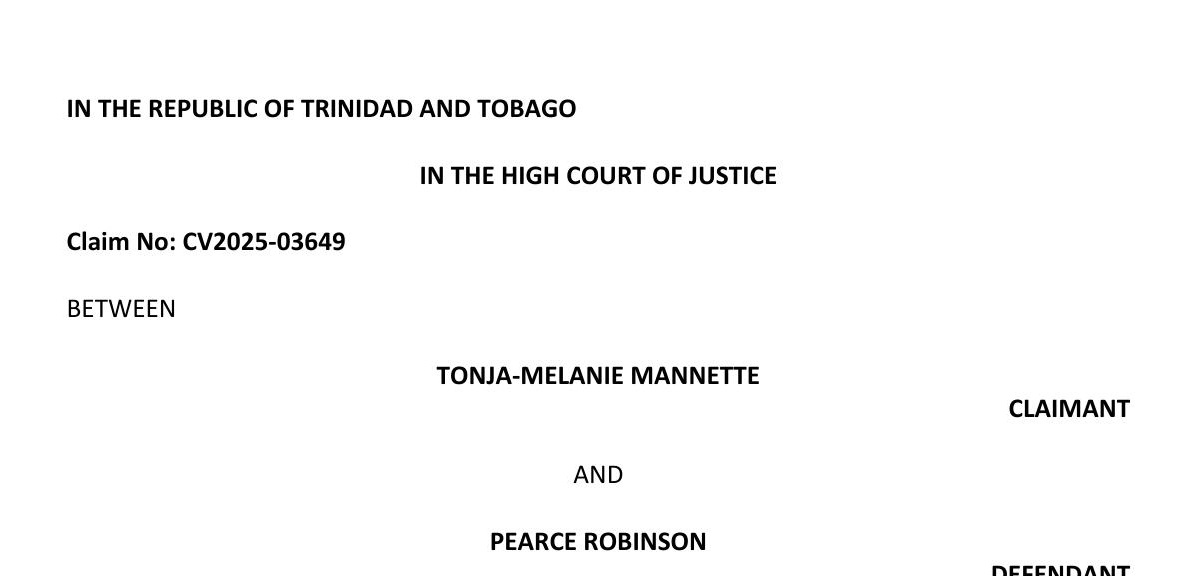
The High Court found Pearce Robinson liable in defamation in Tonja-Melanie Mannette v Pearce Robinson on 15 September 2026. Justice Westmin R.A. James expressly found that the matters examined were ‘unquestionably matters of public interest’ and that the subject of the broadcast was ‘plainly one of substantial public concern’. The judgment separates the importance of examining national security institutions from the evidence required to identify a particular person in a damaging allegation.[13][4][7]
That distinction runs through the written reasons. At paragraph 93, Justice James described the integrity of the Strategic Services Agency, the relationship between religious bodies and national security agencies and the use of State surveillance resources as ‘unquestionably matters of public interest’. He immediately added: ‘The defence does not fail on that element.’[4]
The public-interest finding
When he turned to qualified privilege and responsible journalism, the judge returned to the same point. Paragraph 113 states: ‘Applying those considerations, the subject of the broadcast was plainly one of substantial public concern. That consideration weighs in the Defendant’s favour. The remaining material considerations do not.’ The whole paragraph matters: it records a favourable finding on public concern and an adverse finding on the remaining material considerations.[7]
The court was assessing a Facebook broadcast made on 14 March 2024. The reasons examine its meaning, the underlying facts, the evidential support for the imputation concerning Mannette and the steps taken before publication. Public interest is one element of that assessment. The judge then examines the publication’s treatment of the individual claimant.[5][12][13]
The facts the court accepted
Paragraph 84 records: ‘The Defendant proved, and the Claimant admitted, that she was employed by the SSA and was a member of the Jerusalem Bride Church.’ These were accepted facts about employment and membership. The court treated them as neutral facts and required evidence for the further defamatory meaning concerning Mannette.[1][3]
The truth defence turned on that evidential distinction. At paragraph 89, the judge concluded: ‘The defence of truth therefore fails. The Defendant proved only the neutral facts surrounding the defamatory allegation and not the essential sting of the publication.’ The accepted affiliations therefore remain part of the judicial record, alongside the failure to establish the defamatory imputation.[3]
Political comment and an asserted finding
Justice James distinguished between parts of the broadcast. Paragraph 99 recognises Robinson’s views that an election should be called, that parliamentary oversight was required and that the alleged overlap raised governance concerns as political comment. The paragraph then addresses the materially different statements concerning Mannette.[5]
The court assessed the language and presentation of those statements as the asserted findings of an investigation. The fair-comment analysis required recognisable opinion supported by proved or privileged facts. Its conclusion at paragraph 106 is specific: ‘The defence of fair comment or honest opinion therefore fails in relation to the defamatory imputation concerning the Claimant.’[5][6]
Confidential sources and the trial evidence
The reasons give particular attention to the source evidence concerning Mannette. Paragraph 87 states: ‘His alleged confidential sources were not identified in his witness statement, their proximity to the matters was not established, and their alleged information concerning the Claimant was not particularised.’ The court was evaluating the evidential account placed before it.[2]
Paragraph 116 expands that criticism. The judge said the witness statement had not described the sources or explained their direct knowledge of Mannette, what they said about her, when their information was obtained, whether it was corroborated or whether they had a motive to implicate her. Each is a question about the reliability and specificity of the information supporting the publication.[8]
For reporting involving confidential sources, this passage places the evidential account at the centre of the dispute. It identifies the details the court considered necessary to assess knowledge, corroboration and possible motive. Any challenge to that assessment needs to address the evidence and reasoning concerning Mannette individually.[2][8]
Verification and an opportunity to respond
At paragraph 117, Justice James stated: ‘The Defendant’s verification of the Claimant appears to have been limited to confirming her employment and church membership.’ He continued: ‘Those matters did not verify the defamatory sting. They verified only that she belonged to two broad classes of persons.’ The judge assessed verification against the damaging meaning attributed to the broadcast.[9]
Seeking comment was assessed in context. Paragraph 119 opens: ‘An approach to a claimant is not invariably required.’ The judge then explains why he considered an approach practicable here: Mannette could have been asked about the alleged activities and her response could have been included or caused Robinson to reconsider identifying her. The general principle and its application belong together.[10]
The same contextual approach appears in paragraph 121. Justice James said: ‘The absence of legal review is not by itself fatal, particularly for an independent journalist, but it is relevant where grave allegations are made against a private individual upon the basis of unnamed sources and without prior contact.’ The court considered editorial safeguards alongside the other circumstances of publication.[11]
The finding on responsible journalism
Paragraph 123 states: ‘In the circumstances, the Defendant has not established that identifying the Claimant as part of the alleged nexus was the product of responsible journalism. The public importance of the general subject did not justify attaching an unverified allegation of grave misconduct to a private individual.’ Paragraph 124 concludes that qualified privilege fails.[12]
These are distinct findings with distinct functions. The public-interest finding concerns the subject of the broadcast. The adverse finding concerns the evidential support and editorial decision to identify Mannette. Paragraph 127 records the resulting determination: ‘Liability in defamation is therefore established.’[4][7][12][13]
The judgment and the intended challenge
Robinson intends to challenge aspects of the judgment. Any appeal or other procedural development will be recorded with the relevant filed or issued court documents. Until then, the High Court’s findings remain the operative judicial record.
Reporting disclosure
Pearce Robinson, the author, is the defendant in this case. This account is based on the written judgment delivered by the High Court, with numbered extracts available in the on-site Document Room. Publication date: 16 September 2026.
Citations & source document
- [1]Justice James · paragraph 84Employment and membership were provedEmployment and membership were proved. The court accepted these two underlying facts. Its assessment of the defamatory meaning required evidence of the further imputation concerning Mannette individually.
- [2]Justice James · paragraph 87The evidence concerning the claimantThe evidence concerning the claimant. This passage addresses the source evidence presented at trial: proximity, specificity and information concerning the claimant.
- [3]Justice James · paragraph 89TruthTruth. The court distinguished the accepted underlying facts from the defamatory meaning that required proof.
- [4]Justice James · paragraph 93Unquestionably matters of public interestUnquestionably matters of public interest. This is the court’s express finding on the public-interest element of fair comment. The extract leaves out one further subject the paragraph lists alongside these matters.
- [5]Justice James · paragraph 99Recognisable political commentRecognisable political comment. The same paragraph then distinguishes those opinions from the statements concerning the claimant. Paragraphs 100–106 explain why fair comment failed for that imputation.
- [6]Justice James · paragraph 106Fair comment / honest opinionFair comment / honest opinion. The conclusion relates specifically to the defamatory imputation concerning Mannette.
- [7]Justice James · paragraph 113A consideration in Robinson’s favourA consideration in Robinson’s favour. The complete paragraph contains both the favourable public-concern finding and the court’s adverse assessment of the remaining considerations.
- [8]Justice James · paragraph 116Description, knowledge and corroborationDescription, knowledge and corroboration. The judge identifies the evidential questions that remained unanswered in the witness statement.
- [9]Justice James · paragraph 117What verification establishedWhat verification established. Verification of affiliation and verification of the damaging imputation were treated as separate questions.
- [10]Justice James · paragraph 119Seeking the claimant’s responseSeeking the claimant’s response. The rest of paragraph 119 applies that principle to this case: the judge considered that Mannette could readily have been asked about the alleged activities and that her answer could have been included or prompted reconsideration of naming her.
- [11]Justice James · paragraph 121Editorial and legal reviewEditorial and legal review. The paragraph records the absence of editor or legal-adviser review and assesses it alongside the seriousness of the allegations, sources and prior contact.
- [12]Justice James · paragraph 123The decision to identify MannetteThe decision to identify Mannette. Paragraph 124 concludes that qualified privilege fails. This is a finding about the publication and evidence in this case.
- [13]Justice James · paragraph 127Liability establishedLiability established. Paragraphs 125–127 set out the court’s conclusion. The order at paragraph 180 enters judgment for the claimant for libel.
Every document cited above is held on this site, with the key clauses, extracts and findings set out in full and a link to the document of record.
Cite this article
Outlets, researchers and broadcasters may quote this reporting with credit and a link to the original.
Robinson, P. (16 September 2026). "Mannette v Robinson: what the High Court actually found". PearceRobinson.com. https://pearcerobinson.com/reporting/mannette-v-robinson-what-the-high-court-found
Independent reporting by Pearce Robinson. Corrections and responses may be submitted here.